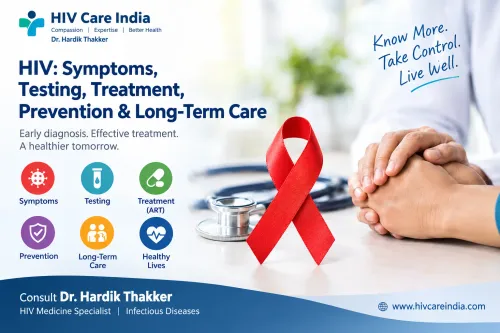
Early and accurate HIV testing plays an important role in diagnosis and timely treatment. Modern laboratory methods can detect HIV infection earlier than traditional antibody-only tests, helping identify recent infections and support prompt medical care.
What Are Advanced HIV Screening Tests?
Advanced HIV screening generally refers to modern tests that can detect HIV antibodies, HIV p24 antigen, or the virus's genetic material (HIV RNA). The main laboratory approaches are antigen/antibody combination tests and nucleic acid tests (NATs).
These tests are particularly useful when recent HIV exposure is suspected, because the virus may be detectable before the body produces enough antibodies to be identified by an antibody-only test.
1. HIV-1/2 Antigen/Antibody Combination Test
2. HIV Nucleic Acid Test (NAT)
3. HIV-1/HIV-2 Antibody Differentiation Test
4. HIV RNA Testing for Suspected Acute Infection
Why Advanced HIV Testing Matters
Modern HIV testing offers several important benefits:
Earlier detection of recent infections
Better identification of acute HIV infection
More reliable diagnostic algorithms
Faster linkage to HIV care
Helps healthcare professionals select appropriate follow-up testing
Early diagnosis allows people with HIV to begin appropriate medical care sooner. Current HIV guidelines recommend starting antiretroviral therapy as soon as possible after diagnosis, when clinically appropriate.
Who Should Consider HIV Testing?
HIV testing may be recommended as part of routine healthcare or when there has been a possible exposure. People with symptoms suggestive of acute HIV infection or a recent potential exposure should speak with a healthcare professional about which test is most appropriate and when it should be performed.
Advanced HIV screening tests have significantly improved the ability to detect HIV earlier and accurately. 4th-generation antigen/antibody testing, antibody differentiation assays and HIV RNA/NAT testing each have specific roles in the diagnostic process.
If you have had a possible HIV exposure, don't rely on symptoms alone. Book a consultation on 08042752572 with the HIV specialist Dr. Hardik Thakker.
What Are Advanced HIV Screening Tests?
Advanced HIV screening generally refers to modern tests that can detect HIV antibodies, HIV p24 antigen, or the virus's genetic material (HIV RNA). The main laboratory approaches are antigen/antibody combination tests and nucleic acid tests (NATs).
These tests are particularly useful when recent HIV exposure is suspected, because the virus may be detectable before the body produces enough antibodies to be identified by an antibody-only test.
1. HIV-1/2 Antigen/Antibody Combination Test
2. HIV Nucleic Acid Test (NAT)
3. HIV-1/HIV-2 Antibody Differentiation Test
4. HIV RNA Testing for Suspected Acute Infection
Why Advanced HIV Testing Matters
Modern HIV testing offers several important benefits:
Earlier detection of recent infections
Better identification of acute HIV infection
More reliable diagnostic algorithms
Faster linkage to HIV care
Helps healthcare professionals select appropriate follow-up testing
Early diagnosis allows people with HIV to begin appropriate medical care sooner. Current HIV guidelines recommend starting antiretroviral therapy as soon as possible after diagnosis, when clinically appropriate.
Who Should Consider HIV Testing?
HIV testing may be recommended as part of routine healthcare or when there has been a possible exposure. People with symptoms suggestive of acute HIV infection or a recent potential exposure should speak with a healthcare professional about which test is most appropriate and when it should be performed.
Advanced HIV screening tests have significantly improved the ability to detect HIV earlier and accurately. 4th-generation antigen/antibody testing, antibody differentiation assays and HIV RNA/NAT testing each have specific roles in the diagnostic process.
If you have had a possible HIV exposure, don't rely on symptoms alone. Book a consultation on 08042752572 with the HIV specialist Dr. Hardik Thakker.
Keywords